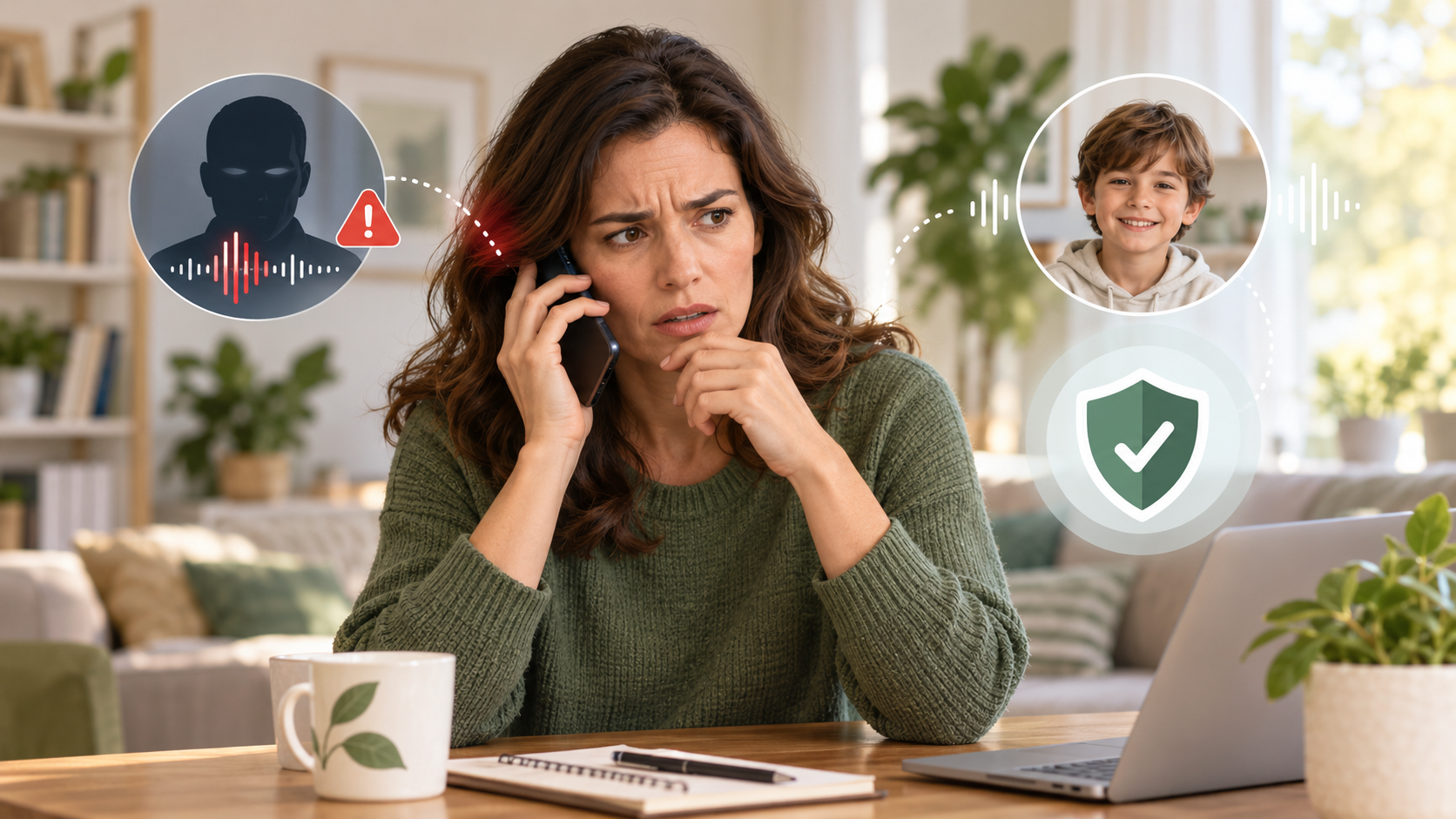

For years, recognising a loved one’s voice felt like strong proof that the person on the phone was really them.
That assumption is becoming less reliable.
Modern voice-cloning tools can imitate a person’s speech using recorded audio. A scammer may combine a familiar-sounding voice with an emotional story and urgent request for money.
Families do not need to become experts in artificial intelligence.
They need a simple verification process.
1. The call creates immediate emotional pressure
A voice scam may involve crying, panic, injury, arrest, a lost phone or another emergency.
Strong emotion makes people focus on helping rather than verifying.
If the call creates fear and demands immediate action, treat urgency itself as a reason to verify.
2. The caller does not want you to hang up
A scammer may try to keep control of the conversation.
They may tell you not to call anyone else.
They may claim that another phone cannot be used.
They may insist that any delay will make the situation worse.
A real emergency does not remove the need for identity verification.
3. The voice sounds familiar but the conversation feels unusual
Do not focus only on whether the voice sounds right.
Think about behaviour.
Does the person normally speak this way?
Would they normally ask you for money in this manner?
Are they avoiding personal questions?
Does the story fit what you know about their current situation?
A familiar voice combined with unfamiliar behaviour deserves caution.
4. The caller asks for secrecy
A common manipulation tactic is asking the target not to tell anyone else.
The caller may say that the situation is embarrassing, confidential or dangerous.
Secrecy prevents the victim from getting a second opinion.
Unexpected requests for secrecy should increase verification, not reduce it.
5. The payment request is unusual
Be cautious if the caller asks for payment through:
• Gift cards
• Cryptocurrency
• An unfamiliar bank account
• A new payment app
• A third party
• Another difficult-to-reverse method
Even when the voice sounds convincing, unusual payment instructions should trigger a separate check.
6. The caller cannot answer a private family question
A family verification phrase or carefully chosen personal question can provide another layer of confirmation.
Do not use information that is easily available online.
The purpose is not to create a perfect password system.
It is to interrupt the scammer’s script and create an independent identity check.
7. A direct call-back gives a different result
If possible, hang up and call the family member using a number already saved in your phone.
If they answer normally and know nothing about the emergency, the situation becomes clear.
If they do not answer, contact another trusted person who may know where they are.
Do not rely only on the number that called you.
What families can do before a voice scam happens
Agree that urgent money requests always require verification.
Create a family phrase.
Know who should be contacted if someone cannot be reached.
Talk openly about AI impersonation so that a realistic voice does not automatically create trust.
The best time to build these habits is before an emergency call arrives.
Final Thought
AI voice scams change one important assumption: hearing a familiar voice is no longer enough to prove identity.
The solution is not panic.
It is verification.
Pause, call back independently, use a family verification method and involve another trusted person before money or sensitive information changes hands.
Recommended Reading
Is That Really You?
The Family Protection Plan for AI Voice Clones, Fake Bank Calls, Imposter Scams & Online Fraud.
Explore the full LeaforaBooks guide for a practical family protection system covering voice clones, impersonation calls, suspicious payment requests and scam-response planning.